Anchors
I'm the Werewolf in my ClassAnchors are the mental and emotional points of connection that help a werewolf stay grounded in the human side during moments of transformation or stress. In Sebastian Wolfe’s story, they turn control from a matter of suppressing the wolf into a practice of maintaining contact with the people, memories, and rhythms that make him human. The concept is therefore both a survival technique and a model for integrating an identity that can no longer be divided neatly between boy and wolf.
Definition and Function
Lily explains Anchors to Sebastian after he struggles with the aftermath of his first transformations. She describes them as things that keep a werewolf grounded in the human side and presents them as practical supports rather than mysterious powers. Control comes through repeated practice, and an Anchor gives that practice a particular focus when the wolf begins to dominate awareness.
The examples are personal rather than universal. Lily uses music: when she feels herself losing control, she concentrates on a song and lets its rhythm calm her. Ethan relies on his family. These examples establish that an Anchor is not a fixed object or prescribed ritual. It is a meaningful connection capable of recalling a werewolf to a chosen human identity. The same principle can therefore operate through sound, family attachment, memory, or another stabilizing bond, provided that it genuinely matters to the individual.
Sebastian’s Discovery of an Anchor
Sebastian has to identify his own Anchor while his new nature is still frightening and unpredictable. His mind turns toward Mia’s smile, Alex’s laugh, and his sister’s irritating but affectionate presence. The sequence is important because it gathers several ordinary human relationships into the emotional center of his supernatural crisis. Sebastian does not locate humanity in an abstract rule or in a denial that the wolf exists; he locates it in the familiar people who connect him to his previous life.
Lily’s instruction is consequently not to fight the wolf but to learn to work with it. That distinction changes the meaning of control. The wolf is now part of Sebastian, and an Anchor does not erase or defeat it. Instead, the technique allows Sebastian to recognize the wolf without surrendering the relationships and values that shaped him before his first transformation. Anchors make coexistence possible by treating human and wolf as parts of one developing self.
Use in School and Crisis
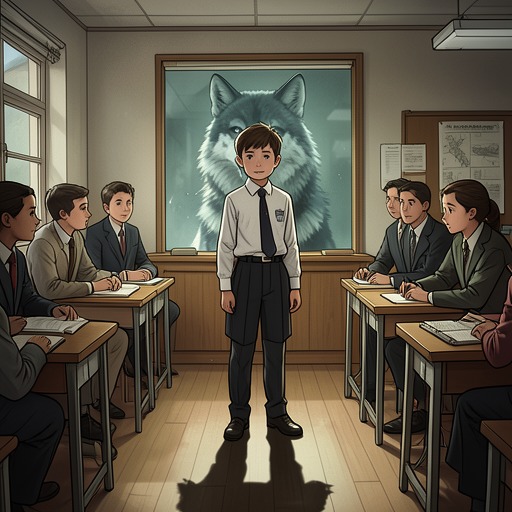
Sebastian immediately applies the idea in History class, where Mia is sitting beside his desk. Her scent overwhelms him, making an ordinary school encounter a direct test of his control. Rather than panic, Sebastian concentrates on the steady rhythm of his own heartbeat, using that bodily rhythm as an Anchor. The moment shows the concept becoming active: a sensation that could have intensified his animal response is reorganized into a stabilizing pattern, allowing him to remain present in the classroom and respond to Mia.
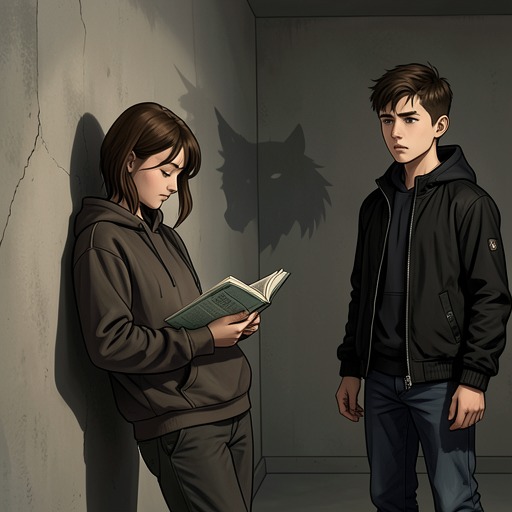
The same method returns when Alex presses him to explain why he has been acting strangely. Sebastian feels trapped, and the wolf stirs in response to his stress. He takes a breath and focuses on his family, friends, and human life before answering carefully that there has been a great deal of family trouble. His explanation is incomplete, but the Anchor prevents the pressure of secrecy from becoming a loss of control. It helps him preserve both his safety and his relationships while he is not yet ready to disclose his werewolf identity.
Anchors Across Transformation
The need for Anchors is established against the violence of Sebastian’s first transformation. On his sixteenth birthday, he experiences shifting bones, crawling skin, and coarse dark hair appearing on his hands; when the full moon emerges, he throws back his head and howls in a voice that is no longer human. Later, at the pack’s meeting in Crescent Hill Park, he consciously allows the wolf inside him to take over and experiences a world made sharper and clearer, with fear and excitement conveyed through scent and the sound of heartbeats.
These scenes distinguish uncontrolled transformation from learned participation. At first, Sebastian is carried by bodily change and fear. After Lily’s guidance, he begins to meet the same inner force with attention and an intentional point of return. His heartbeat, family, friends, and memories do not make the transformation less real; they give him a way to remain himself while reality changes around him.
Meaning and Consequences
Anchors also provide the story’s clearest language for belonging. Sebastian’s parents explain that his transformations will initially be unpredictable but that he will learn control with their help. The pack then welcomes him, with Lily offering recognition and Ethan identifying himself as the Alpha of the group. Within that new community, Anchors become shared knowledge: each member has a different grounding connection, yet all understand the necessity of preserving a human center.
The concept becomes especially significant when the rogues threaten the school and target Sebastian’s connection to the artifact. The danger forces him to move between ordinary student life, family secrecy, pack obligations, and supernatural conflict. Anchors are the internal counterpart to the pack’s external protection: they keep him connected to human relationships while the pack gives him a community capable of acting with him.
At the clock tower, Sebastian’s transformation exceeds the familiar division between human and wolf. As the full moon shines through the clock face and the artifact, his blood, and the prophecy converge, he becomes a synthesis of both rather than merely one form replacing the other. Later, Ethan says that the artifact has unlocked abilities beyond what the pack thought possible and that Sebastian is something new. The Anchors prepare the conceptual ground for this development: integration is not failure, and accepting the wolf does not require abandoning the human self.
By the end, Sebastian remains uncertain about what his new abilities mean for his future, his place in the pack, and his life as a normal teenager. Mia reassures him that he is not alone, while the narrative closes on his sense that he has finally come home. Anchors thus develop from a technique for surviving transformation into a broader principle of identity. They show that stability does not depend on returning to an earlier, supposedly normal self; it can arise from carrying human attachments forward into an altered life.